Entity
An entity in RIDDL is the same as it is in DDD which defines it this way:
Hint
Entity Definition-
An object primarily defined by its identity is called an Entity. Many objects are not fundamentally defined by their attributes, but rather by a thread of continuity and identity.
There are three main aspects to this definition of entity:
- Entities in the software implementation of the model are objects,
containing both state and function. They can both be and do.
This means they can represent any physical object, a concept, etc. - Entities have an identity; they are identified by some unique value that no other entity of the same type may have.
- Entities are continuous; they have a lifecycle, evolving from creation, through their useful lifespan, to destruction.
An entity is the fundamental processor of work in a reactive system and in a RIDDL model. Entities are most often implemented in software using one of these techniques:
- The actor model, where actors process messages and encapsulate state
- Object-oriented programming, which also encapsulates state and defines functions to manipulate that state
- Functional programming, where a collection of functions process messages or function calls using exclusive access to some data and a queue of messages; this simulates the actor model
Identity
Entities have a unique immutable persistent identifier, much like people have names except our personal names are not unique. The unique identifier is used to locate the entity in a computing system and for other computing purposes. These immutable and unique identifiers convey equivalence. That is, when two values of an identifier are the same, then by definition, they must refer to the same entity. Changing the state of the entity does not break this equivalence.
RIDDL provides Type Id for this purpose, giving you
a way to reference an entity within its context or across contexts. While an
entity's identity is immutable, the individual pieces of data it holds can
change their values (mutable).
Equality
Entities hold state, whether that state is persistent or not. However, for entities, the most important state value is the unique identifier for that entity. Consider this diagram:
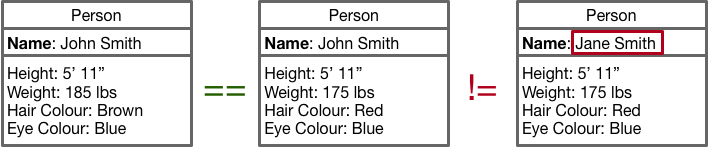
Two instances of the same Entity may have different attribute values, but because both instances have the same identity value, they represent the same Entity. The identifier "John Smith" is used in two entities that differ in their state. By definition, this means they refer to the same entity. However, when you compare "John Smith" with "Jane Smith", they are not the same entity, even if all their other attributes are the same.
Intentions
Six words written before entity say what the entity means. They are
not options, because a generator may not treat them as hints:
They fall into three independent groups, and any order parses:
| Group | Word | Meaning |
|---|---|---|
| Role | aggregate |
An aggregate root: commands and queries for the entities it aggregates go through it |
| Consistency | consistent |
Favour consistency over availability, in Eric Brewer's CAP theorem |
available |
Favour availability over consistency | |
| Persistence | event-sourced |
Store state as a log of the entity's own events, rebuilt by replay |
persistent |
Store only the latest value, with no event log | |
transient |
Keep state in memory only; it is lost when the service stops |
These were options before 2.0
option is event-sourced, aggregate, transient, consistent and
available in a with { } block still parse, but each emits a
[deprecated] message (entity-option-to-intention), and they are slated
for removal in 3.0. option is value is the old spelling of persistent.
riddlc prettify moves all of them in front of entity.
event-sourced is enforced
event-sourced is not decoration. It turns on Errors that a CRUD entity never
sees. Every handled command must declare the event it yields. State may
change only in an on event clause for one of the entity's own events. And
such a fold may not read system.now or system.random, because a replay
would rebuild a different state. See
Event Sourcing Rules
for each rule.
Does the journal earn its keep?
riddlc also counts what an entity does with the journal it asked for, and reports what it finds as an Advisory. An Advisory is not a warning: it never blocks generation, and a modeller may dismiss it by design. Each one describes a fact about the model that is unusual for what the declaration normally means:
entity-event-sourced-unread-history: the entity isevent-sourced, but has one state, no transitions, and none of its events is handled anywhere else. The journal has no reader but the entity. If only the latest row matters, this is apersistententity. If history matters, model what reads it: a projector or saga handling its events.entity-event-sourced-snapshot-events: every event carries the whole state, and every fold copies it straight back. Replay then reproduces only the last row, so the journal buys a durable log and nothing else. If the history is meant to carry meaning, record what changed in each event.entity-crud-with-transitions-consumed, the inverse: the entity is not event-sourced, but it has several states and transitions, and other processors handle the events it yields. Its history is being consumed from a store that keeps only the latest row. If the consumers need the history, declare itevent-sourced; if the latest row is all they need, it is fine as written.
A fourth count, entity-event-sourced-prose-folds, reports folds written as
prose (set … to prompt("…")); see
append and remove.
Options
Options go in the entity's with { } block. They are hints to generators
(code, documentation, API, etc.) about how to implement the entity, not
statements about what it means.
technology
- Arguments: Multiple, a list of the names of technologies intended to be used in the implementation.
- Implication: This does not impact the behavior of the entity except in the differences provided by various implementation technologies.
snapshots
- Arguments: None
- Implications: Replay may start from a snapshot rather than from the
beginning of the log. Says only whether, never how often. Legal only on an
event-sourcedentity; elsewhere it is an Error. Its absence means "replay the whole log", and that is a real choice too. Seeoption is snapshots.
finite-state-machine
- Arguments: None
- Implications: The entity is intended to implement a finite state machine.
message-queue
- Arguments: None
- Implications: The entity should allow receipt of commands and queries via a message queue.
auto-id
- Arguments: None
- Implications: The entity is assigned a ULID automatically at instantiation, rather than the model supplying an identifier.
kind
- Arguments: one string indicating the kind of entity
- Implications: The general kind of entity being defined. This option takes a single value which provides the kind of entity. Examples of useful kinds are "device", "user", "concept", "machine". This entity option may be used by downstream AST processors, especially code generators. Downstream processors may require additional entity kind values.
Lifecycle Handlers
An entity has two pairs of lifecycle on clauses, and they mean different things:
| Clause | Fires |
|---|---|
on init / on term |
Once ever, at creation and destruction. on init morphs into the starting state |
on activate / on passivate |
Every time, at rehydration and eviction |
An entity that is evicted from memory and later rehydrated passivates and activates repeatedly without ever being initialized or terminated again. That distinction matters for anything cached or connection-scoped.
record AccountData is { accountNumber: String }

entity Account is {
  handler Lifecycle is {
    on init(number: String) is {
      morph entity Account to state Open
        with record AccountData(accountNumber = number)
    }
    on activate  { do "warm the pricing cache" }
    on passivate { do "flush the pricing cache" }
    on term      { do "archive the account record" }
  }
  state Open of record AccountData is { handler OpenHandler is { ??? } }
}
An entity has no initial state (since 2.8.0). It is created with none, and
its entity-level on init morphs it into the state it starts in, chosen from
the creation arguments. The initial state marker and starting in the first
declared state are deprecated until 3.0; see
State. A state can also run an action each
time it is entered, with on entry.
on activate and on passivate are entity-only and must be side-effect
free: send, tell, yield, morph and become are rejected at parse time.
Entities Bear Ports
An entity is a processor, so it may declare inlets and outlets — which is how it publishes its events into a stream:
entity Order is {
  outlet OrderEvents is event OrderPlaced

  handler OrderLifecycle is {
    on init(start: OrderData) is { morph entity Order to state Active with start }
  }
  state Active of record OrderData is {
    handler H is {
      on cmd: command PlaceOrder {
        send event OrderPlaced(cmd.id) to outlet OrderEvents
      }
    }
  }
}
Occurs In
Contains
flowchart TD
    Entity(["Entity"]) --> State
    Entity --> PC["Processor contents"]
    State --> Handler
    State --> Invariant