What is RIDDL Based On?
The RIDDL specification language borrows concepts from:
- Domain Driven Design (DDD)
- Reactive System Architecture (RSA)
- C4 Model Of Software Architecture
- Akka
- Jacobsen Use Cases 2.0
- Agile User Stories
- Behavior Driven Development (BDD)
- Finite State Machines
- Command/Query Separation
- CQRS
- Event Sourcing
- Saga Pattern
- Unified Modeling Language (UML)
RIDDL aims to capture business concepts, system designs, and architectural details in a way that is consumable by business professionals yet structured enough to enable translation into various artifacts:
- Living documentation that stays in sync with the model
- Architectural diagrams (context maps, sequence diagrams, state machines)
- Code scaffolding and implementation templates
- API specifications and deployment configurations
Because RIDDL captures both structure and intent, delivery teams can iterate on the design while tools generate appropriate outputs for each stage of development.
Domain Driven Design (DDD)
RIDDL is based on concepts from DDD. This allows domain experts and technical teams to work at a higher level of abstraction by co-creating a ubiquitous language for the target domain enabling them to develop a system specification that is familiar and comprehensible by business and technical leaders alike.
For best comprehension of the RIDDL language, it is best to be familiar with DDD concepts. For a four-minute overview watch this video. For a more in depth understanding we recommend reading Vaughn Vernon's more concise book Domain Driven Design Distilled, or Eric Evans' original tome Domain Driven Design: Tackling Complexity in the Heart of Software.
Key DDD Terms Used in RIDDL
| DDD Term | RIDDL Equivalent | Description |
|---|---|---|
| Bounded Context | context |
A boundary within which a particular model and ubiquitous language apply |
| Entity | entity |
An object with a unique identity that persists over time |
| Value Object | type |
An immutable object defined by its attributes, not identity |
| Aggregate | entity (with aggregate option) |
A cluster of entities and value objects with a single root |
| Domain Event | event |
A record of something significant that happened in the domain |
| Command | command |
A request for the system to perform an action |
| Repository | repository |
Abstraction for storing and retrieving aggregates |
| Anti-Corruption Layer | adaptor |
Translation layer between bounded contexts |
| Ubiquitous Language | term definitions |
Shared vocabulary used by team and code |
For a comprehensive DDD glossary, see the excellent DDD Glossary at archi-lab.io.
Reactive System Architecture (RSA)
The Reactive Manifesto was authored in 2014 by Jonas Bonér, Dave Farley, Roland Kuhn, and Martin Thompson. As the computing landscape evolved and companies began to operate at "internet scale" it became evident that the old ways of constructing systems were not adequate. We needed an approach to system architecture back then that was fundamentally different in order to meet user expectations.
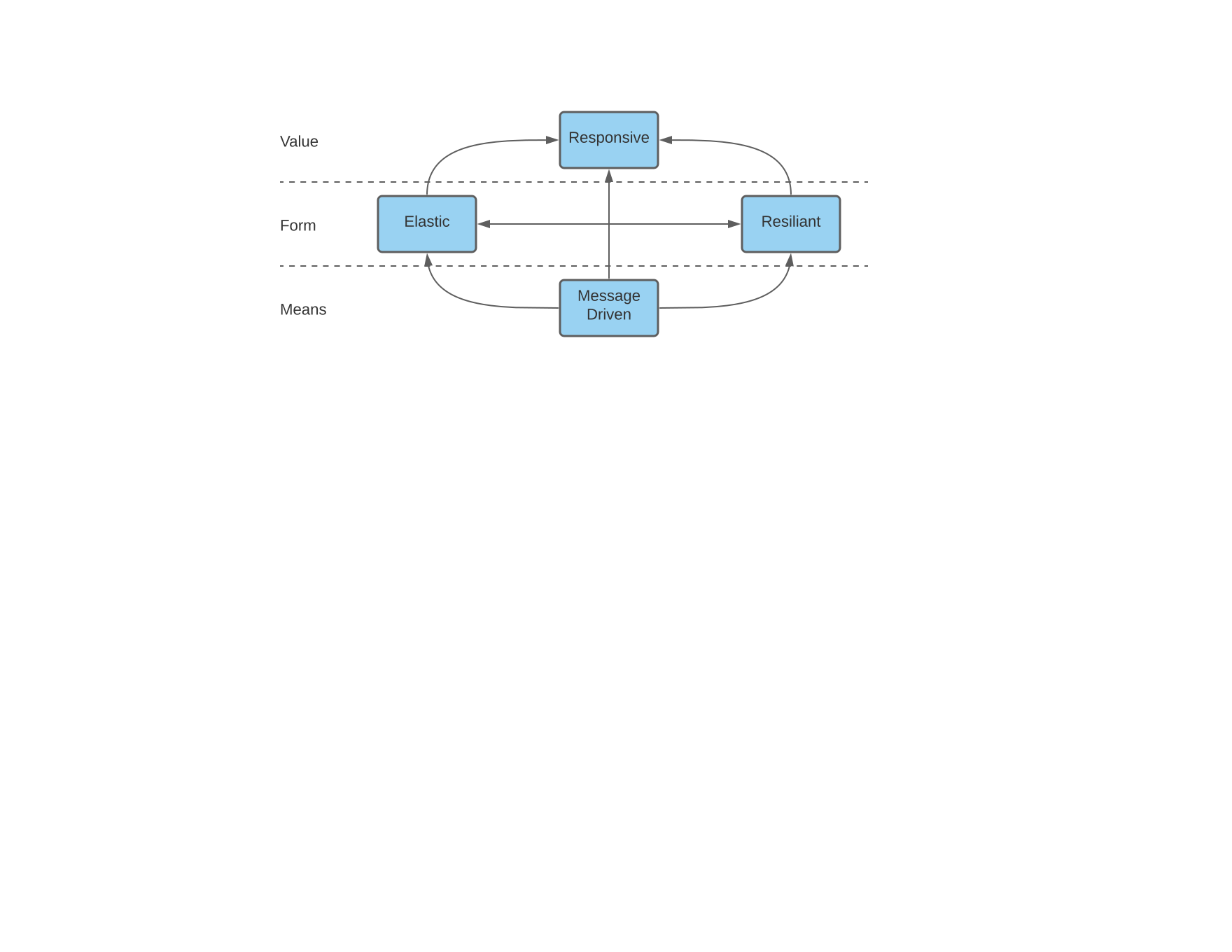
The central thesis of reactive architectures is that the overriding objective in any system must be responsiveness. Users are conditioned to expect systems that perform well and are generally available. If these conditions are not met, users tend to go elsewhere to get what they want. That, of course, is clearly unacceptable for any business endeavor. To remain responsive to users, a system must address several challenges:
- system or component failure (resiliency)
- increasing work load (scalability)
- high operational cost (efficiency)
- slow responses (performance)
A reactive system aims to be responsive in the face of all of these challenges.
Without going into too much detail here, among the key means of achieving responsiveness is to decompose the concerns of a domain into well isolated blocks of functionality (DDD), and then, establishing clear non-blocking, asynchronous, message-driven interfaces between them. Together, the concepts of, Responsiveness, Elasticity, Resiliency, and Message-Driven form the basis of a Reactive Architecture.
To get more information on Reactive Architecture please refer to the excellent 6 part course by Lightbend. You can find the first course in that series here.
Unified Modeling Language (UML)
One of the key insights brought forward by UML is that it is far easier for humans to comprehend the intended design of a system by communicating these ideas with pictures. UML is a language of very precise graphical symbols that communicate different concerns of a system design.
This idea has been further leveraged by other design artifacts and activities. For example, a very common DDD exercise is called Event Storming. In this exercise a group of experts brainstorms about the things that happen, concrete events, within a system. Event Storming uses a very low fidelity tool to capture the details of the exercise. In this exercise, traditionally events are captured first on orange sticky notes. The commands that generate those notes are then captured on blue stickies. And the actors that initiate those commands are captured on yellow stickies. And so on. More information on event storming can be found here and here
RIDDL uses many of the design artifacts detailed under the UML specification to help communicate the design and intent of a system. For example, Sequence Diagrams are used extensively to document the interactions between bounded contexts in a system. A State Machine Diagram may be used to document the lifecycle of an entity or user in a system, and so on. However, RIDDL's diagram output is not limited to UML diagrams. Peter Chen's 1971 invention of the entity relationship diagram is very well adapted to the concept of entity in DDD. DDD also has its own diagrams: * the System Context Diagram provides a depiction of the actors, internal systems, external systems, and how they interact (use cases). * the Context Map is a high level diagram that portrays the general relationships between bounded contexts. * Business Use Case Diagram - same idea as the UML version but simpler
More on that can be found here
Jacobsen Use Cases 2.0
Ivar Jacobson, one of the founders of UML, developed Use Case 2.0 as a modernized, lightweight approach to capturing system requirements.
Key principles from Use Case 2.0 that influence RIDDL:
-
Slices: Use cases are "sliced" into smaller, implementable pieces that deliver value incrementally. RIDDL's
casedefinitions within anepicsupport this incremental approach. -
Stories within Use Cases: Use Case 2.0 bridges traditional use cases with agile user stories. RIDDL combines both: epics contain the high-level user goal while cases capture specific interaction flows.
-
Test-Driven: Use cases directly inform test scenarios. RIDDL's structured cases can be translated into acceptance tests.
-
Lightweight: Use Case 2.0 emphasizes capturing just enough detail. RIDDL follows this by allowing both detailed specifications and high-level
???placeholders during iterative refinement.
Example of Use Case 2.0 concepts in RIDDL:
epic Checkout is {
  user Customer wants to "complete a purchase"
  so that "they receive their ordered items"

  // Each case is a "slice" of the use case
  case EnterShippingInfo is { /* ... */ }
  case SelectPaymentMethod is { /* ... */ }
  case ReviewAndConfirm is { /* ... */ }
  case ReceiveConfirmation is { /* ... */ }
}
Agile User Stories
Agile user stories are used to capture the requirements of various components
within a system. In RIDDL, user stories are part of an
epic definition
As a [persona], I [want to], [so that]...
In other words, it provides WHO (persona), WHAT (want to), and WHY (so that).
Behavior Driven Design (BDD)
Behavior-driven development was pioneered by Daniel Terhorst-North. It grew from a response to test-driven development (TDD), as a way to help programmers on new agile teams “get straight to the good stuff” of knowing how to approach testing and coding, and minimize misunderstandings. BDD has evolved into both analysis and automated testing at the acceptance level. Cucumber Documentation
BDD provides a simple specification language named Gherkin which is used heavily in RIDDL. Even if you are not familiar with the Gherkin language, it is simple enough and intuitive enough to be grasped quickly.
Gherkin scenarios follow a simple structural pattern, like this:
- SCENARIO: \<scenario description>
- GIVEN \<a precondition>
- WHEN \<an event occurs>
- THEN \<take an action>
RIDDL uses this structure to inform how handlers should process messages. While RIDDL's statements aren't as rigid as Gherkin's Given-When-Then format, the influence is clear: handlers respond to events (Given a condition, When an event occurs) and take actions (Then do something).
If you've worked in agile circles or considered BDD as a tool for testing, you'll find RIDDL's approach familiar. The emphasis on behavior over implementation details, and the use of natural language to describe actions, draws directly from BDD's philosophy.